
From Garden to Kitchen: Horseradish Health Benefits, Growing Tips, and My No-Tears Shredding Trick 🌿

From Garden to Kitchen: Horseradish Health Benefits, Growing Tips, and My No-Tears Shredding Trick 🌿
I grow horseradish in my garden, and every once in a while, I dig up a few roots for the kitchen.
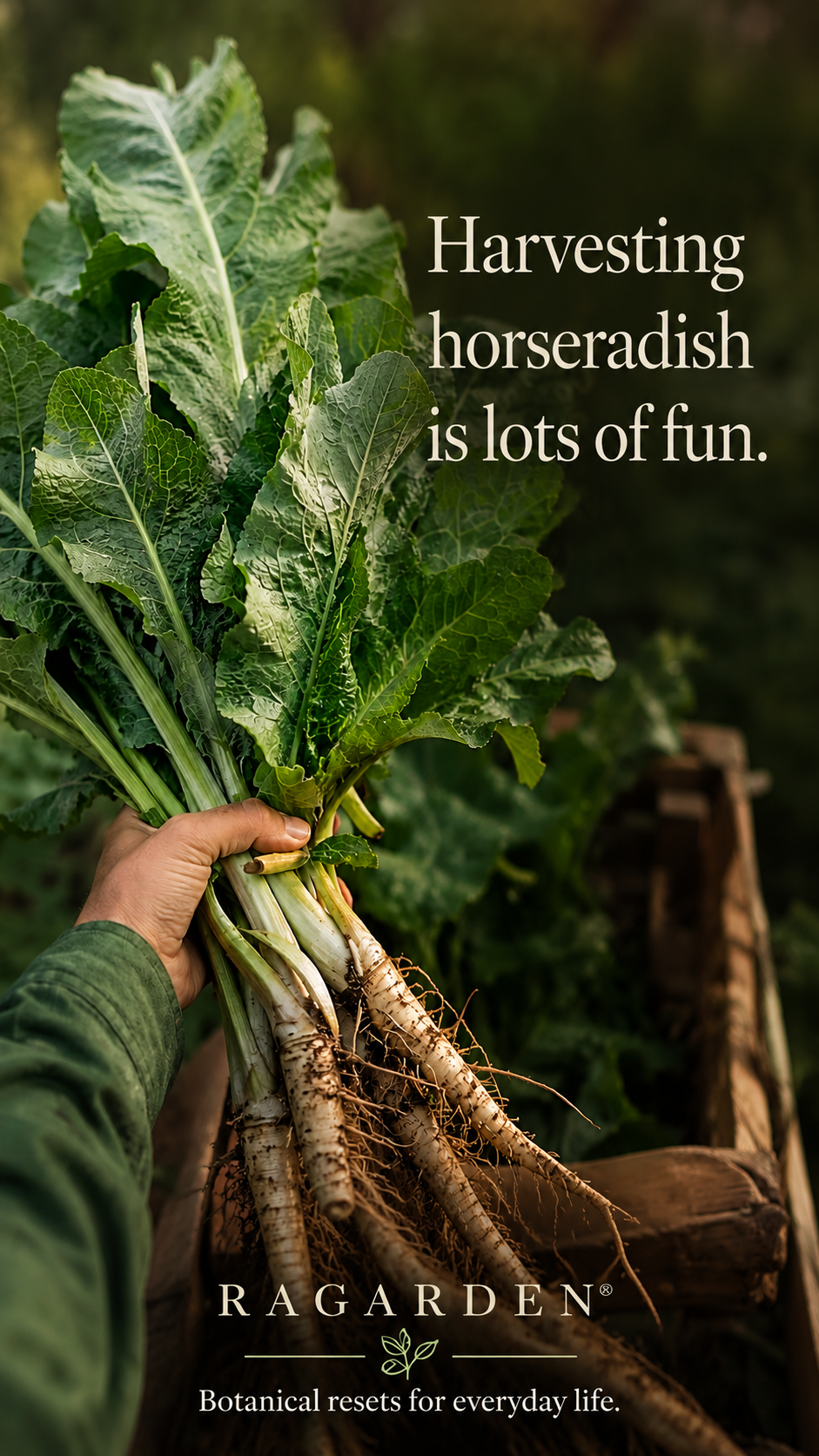
Harvesting is exciting. The roots are fresh, aromatic, and full of possibilities.
Then comes the shredding.
Anyone who has ever grated freshly harvested horseradish knows exactly what I mean. One minute, everything is fine. The next minute, your eyes are watering, your nose is running, and you are crying as though you are watching the saddest movie ever. 😂
For years, processing fresh horseradish felt like a little kitchen torture.
Then I had my Eureka moment!
I attached a food-safe pastry bag to the outlet of my meat grinder and secured it with a rubber band. The freshly shredded horseradish went directly into the bag, helping keep much of its powerful aroma contained.
More horseradish.Fewer tears.Happy Marina. 😄
But before I share my kitchen trick, let us look at what makes this unusual garden root so powerful.
What Is Horseradish?
Horseradish, botanically known as Armoracia rusticana, is a hardy perennial plant in the Brassicaceae family—the same botanical family as mustard, cabbage, broccoli, radishes, and wasabi. It is grown mainly for its thick white root and has been valued as a culinary plant for thousands of years. (University of Minnesota Extension)
The whole root has surprisingly little aroma while it is intact.
The fireworks begin when the root is cut, crushed, or shredded.
Breaking the plant cells allows naturally occurring glucosinolates to interact with an enzyme called myrosinase. This reaction creates pungent sulfur-containing compounds called isothiocyanates. These volatile compounds are responsible for horseradish’s intense flavor—and for the tears that appear while we are processing it. (PubMed)
In other words:
The stronger the fresh aroma, the more your horseradish is reminding you that it is a member of the mustard family. 🌿😂
Potential Health Benefits of Horseradish
Horseradish has a long history in traditional food and herbal practices. Modern researchers are especially interested in its glucosinolates, isothiocyanates, phenolic compounds, and antioxidant activity.
However, much of the current research has been conducted in laboratories rather than in large human clinical trials. Horseradish is best enjoyed as a flavorful food—not treated as a cure or replacement for medical care.
1. Horseradish Health Benefits. Source of Protective Plant Compounds
Horseradish contains glucosinolates, with sinigrin being one of the primary compounds identified in the root. When the root is shredded, these compounds are transformed into biologically active isothiocyanates. (PMC)
These are the same general families of plant compounds that have made broccoli, cabbage, mustard, and other cruciferous vegetables important subjects of nutrition research.
The interesting part is that horseradish does not hide its chemistry.
You can smell it.You can taste it.And sometimes you can cry from it. 😂
2. Antioxidant Potential
Laboratory studies have identified antioxidant activity in horseradish extracts. Antioxidants are compounds that help protect cells from oxidative stress, although laboratory antioxidant activity does not automatically translate into a specific disease-prevention benefit in people. (PubMed)
Fresh horseradish is only one small part of a healthy eating pattern, but it can add bold flavor and botanical variety to meals.
3. Antimicrobial Activity in Laboratory Research
Horseradish-derived isothiocyanates have demonstrated antibacterial activity in laboratory studies. Researchers continue to investigate how these compounds interact with different microorganisms. (PubMed)
This research is interesting, but eating horseradish should not be considered a treatment for bacterial infections.
Think of it as a traditional culinary plant with fascinating natural chemistry—not as a replacement for antibiotics or medical care.
4. Possible Anti-Inflammatory Activity
Cell-based research has explored the anti-inflammatory potential of compounds found in horseradish. These early findings are promising, but more human research is needed before specific health conclusions can be made. (PubMed)
For now, I enjoy horseradish for what we know it does very well:
It adds intense flavor, wakes up a meal, and connects the garden directly to the kitchen.
5. Vitamin C and Fiber—in a Small Condiment Serving
Prepared horseradish contains vitamin C and dietary fiber. However, most people eat only a teaspoon or tablespoon at a time, so a normal serving is not a major source of nutrients by itself. (FoodData Central)
Its greatest culinary advantage may be its ability to add a lot of flavor in a very small amount.
A spoonful can transform:
Roast beef
Fish
Eggs
Potatoes
Beets
Homemade sauces
Salad dressings
Vegetable dishes
How I Grow Horseradish in My Garden

Horseradish is one of those plants that asks for patience at the beginning—and then may decide it owns the garden. 😄
Once established, even small root pieces left in the soil can grow into new plants. Texas A&M notes that horseradish can become difficult to remove because new growth may regenerate from root pieces remaining in the ground. (Aggie Horticulture)
That can be wonderful when you want a permanent supply.
It is less wonderful when horseradish begins appearing where you did not invite it.
Tip 1: Choose Its Location Carefully
Plant horseradish in a place where it can remain for many years.
Good choices may include:
A dedicated garden corner
A separate raised bed
A large, deep container
An area with a root barrier
Avoid placing it in the center of a carefully organized vegetable bed unless you are comfortable with it staying there.
In my garden, I harvest roots occasionally and allow the established plant to continue growing.
Tip 2: Give the Roots Deep, Loose Soil
Horseradish produces its best roots in fertile, deep, well-drained soil. Hard, compacted, rocky, or shallow soil can contribute to smaller, branched, or misshapen roots. (University of Minnesota Extension)
Before planting:
Work compost or well-decomposed organic matter into the soil.
Loosen the planting area deeply.
Avoid adding fresh manure immediately before planting because excessive nitrogen may encourage leafy growth and contribute to irregular roots. (University of Minnesota Extension)
Tip 3: Plant Root Cuttings
Horseradish is usually propagated from pieces of root rather than from seed.
Root cuttings can be planted in late winter or early spring. Texas growing guidance recommends fertile, well-drained soil and planting stored side-root pieces as the new growing season begins. (Aggie Horticulture)
Planting methods vary, but root cuttings are commonly placed several inches deep and spaced far enough apart to allow the large leaves and underground roots to develop. (MSU Extension)
Tip 4: Mulch and Water Consistently
Horseradish is a strong plant, but steady moisture encourages better root development.
In our hot Houston summers, I find mulch especially helpful. It protects the soil surface, slows moisture loss, and helps keep the root zone cooler.
Avoid allowing the soil to remain constantly waterlogged. The goal is evenly moist, well-drained soil—not swampy soil.
Tip 5: Remember That the Leaves Can Become Large
A mature horseradish plant does not look small or delicate.
Its broad green leaves can create a large, dramatic garden plant. Give it enough space so it does not shade smaller vegetables.
And remember: a healthy plant above ground may be developing a surprisingly large root system underneath.
When and How to Harvest Horseradish
In East Texas, horseradish is traditionally harvested in late fall. Cooler-season harvesting is often convenient because the plant’s top growth begins slowing and garden temperatures are more comfortable. (Aggie Horticulture)
I also harvest a few roots occasionally when I need them.
To harvest:
Loosen the soil around the plant with a garden fork or shovel.
Dig carefully so you do not accidentally cut every root into small pieces.
Remove the roots you plan to use.
Leave part of the established crown or save healthy side-root pieces when you want the plant to continue growing.
Remove as many root fragments as possible when you do not want horseradish spreading into that area.
Freshly dug roots can be covered and refrigerated until you are ready to process them.
Why Shredding Fresh Horseradish Makes Us Cry
The root’s powerful compounds are released only after its cells are damaged.
The moment the grinder begins working, fresh plant tissue is crushed continuously. Volatile isothiocyanates are released into the surrounding air, where they can irritate the eyes, nose, mouth, and respiratory passages. (PMC)
That explains why shredding a large harvest can become uncomfortable very quickly.
And that is exactly why I started looking for a better method.
My No-Tears Horseradish Shredding Trick 🌿😂
One day, I looked at my meat grinder and thought:
What if the shredded horseradish went directly into a bag?
Eureka! 💡
I placed a large, food-safe pastry bag over the grinder outlet and secured it around the stationary outside portion with a rubber band.
As the horseradish was processed, the shredded root traveled directly into the bag.
Instead of allowing every fresh vapor to spread throughout the kitchen, the bag helped contain much of the intense aroma near the source.
The reaction still happens.
The horseradish is still powerful.
But my eyes are much happier. 😄
Step-by-Step: My Horseradish Grinder Method
Step 1: Clean the roots
Wash away all soil.
Trim damaged areas and peel the outside when needed.
Cut the roots into pieces that fit safely into your grinder.
Step 2: Prepare the grinder
Assemble the meat grinder according to the manufacturer’s directions.
Place a bowl underneath as backup.
Use the speed recommended for your specific grinder.
Step 3: Attach a food-safe pastry bag
Place a large, sturdy, food-safe pastry or piping bag over the grinder’s discharge outlet.
Secure it gently with a rubber band around the stationary exterior portion only.
Keep all rubber bands, plastic, hands, clothing, and loose materials completely away from moving parts.
Step 4: Begin shredding
Feed the root through the grinder using the manufacturer-provided food pusher.
Never place fingers inside the grinder opening.
Watch the bag as it fills.
The shredded root should move freely into the bag. Stop the grinder if the flow becomes restricted, the bag becomes overly full, or the food begins backing up.
Step 5: Turn off and unplug before removing the bag
Once you finish, turn off the appliance and unplug it before touching or removing any attachments.
Open the pastry bag carefully.
Even though many vapors remained inside, they did not disappear.
Open it away from your face, preferably beneath a strong kitchen exhaust fan or outdoors.
Safety Note About My Method
This is my personal home-kitchen solution and is not a manufacturer-approved grinder attachment.
Use only a large, food-safe bag.
Never obstruct the grinder outlet.
Never cover appliance vents.
Never allow plastic or rubber bands near moving components.
Do not leave the appliance unattended.
Continue working in a well-ventilated area because fresh horseradish vapors can still escape and irritate the eyes and respiratory passages. (Drugs.com)
Fresh Horseradish Is Powerful—A Little Goes a Long Way
Horseradish is generally used as a culinary seasoning in small amounts.
Because it is intensely pungent, large quantities may irritate the mouth, throat, stomach, and digestive tract. People with sensitive digestive systems may tolerate only small portions. (Drugs.com)
Fresh horseradish should be treated like the strong condiment it is:
Start small.
Taste.
Then decide whether you are brave enough for another spoonful. 😂
People who are pregnant, breastfeeding, managing a medical condition, or considering concentrated medicinal amounts should speak with a qualified healthcare professional before using horseradish beyond ordinary food quantities. (Drugs.com)
Garden Lesson of the Day
Growing food teaches us patience.
Harvesting teaches us appreciation.
And processing fresh horseradish teaches us to become creative very quickly. 😂🌿
My pastry-bag trick turned one of my most uncomfortable garden-to-kitchen jobs into a much easier process.
No special machine.
No complicated equipment.
Just one simple idea:
Keep the horseradish in the bag—and keep the tears out of the kitchen.
More horseradish.Fewer tears.Bingo! 🌿
RAGARDEN® — Botanical resets for everyday life.
Educational Disclaimer
This article is provided for general gardening, culinary, and educational purposes. Information about traditional plant use and preliminary research is not intended to diagnose, treat, cure, or prevent disease and should not replace individualized advice from a physician, pharmacist, registered dietitian, or other qualified healthcare professional.


Comments